
10 Precision Agriculture Irrigation Scheduling Techniques
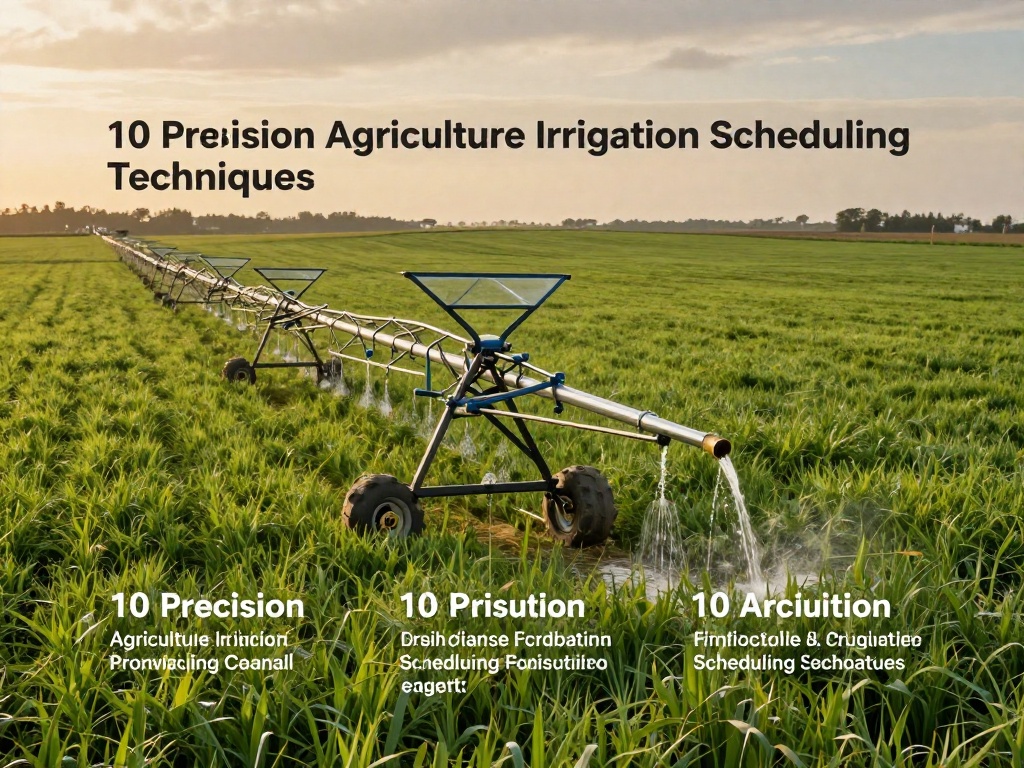
10 Precision Agriculture Irrigation Scheduling Techniques
Water scarcity poses one of the greatest challenges to modern agriculture, making efficient irrigation management essential for sustainable crop production. Precision agriculture irrigation scheduling techniques enable farmers to deliver the right amount of water at the right time, maximizing yields while conserving precious water resources. These advanced methods combine sensor technology, data analytics, and weather information to transform traditional farming into a science-based approach that minimizes waste and optimizes plant health.
1. Soil Moisture Sensor Networks
Soil moisture sensors form the foundation of modern precision irrigation systems, providing real-time data about water availability in the root zone. These devices measure volumetric water content at multiple depths, allowing farmers to understand exactly when and how much to irrigate.
Capacitance-Based Sensors
Capacitance sensors generate an electromagnetic field to measure the dielectric constant of soil, which changes based on moisture levels. These sensors offer excellent accuracy and can be installed at various depths to monitor moisture throughout the root profile. Modern capacitance sensors provide readings every few minutes and integrate seamlessly with automated irrigation controllers.
Time Domain Reflectometry (TDR) Sensors
TDR sensors measure soil moisture by analyzing the speed of electromagnetic pulses through the soil. While more expensive than capacitance sensors, TDR devices provide highly accurate measurements across different soil types. They perform exceptionally well in saline soils where other sensor types may produce unreliable readings.
Wireless Sensor Networks
Wireless soil moisture networks enable monitoring across large fields without extensive wiring. These systems allow farmers to place sensors at multiple representative locations, creating a comprehensive picture of field variability. Cloud-based platforms then aggregate this data for centralized decision-making.
2. Evapotranspiration (ET) Based Scheduling
Evapotranspiration combines water lost through plant transpiration and soil evaporation, representing the total water demand of crops. ET-based scheduling calculates irrigation requirements based on atmospheric conditions, crop type, and growth stage.
Reference ET Calculation Methods
The Penman-Monteith equation serves as the standard method for calculating reference evapotranspiration using weather station data. This approach accounts for temperature, humidity, wind speed, and solar radiation to determine atmospheric water demand. Agricultural Extension services often provide ET data through regional networks.
Crop Coefficient (Kc) Approach
Each crop has a specific water requirement curve throughout its growth cycle, expressed through crop coefficients. By multiplying reference ET by the appropriate Kc value, farmers obtain crop-specific irrigation requirements. These coefficients vary from planting through maturity, reflecting changing plant cover and water needs.
Real-Time Weather Integration
Modern irrigation controllers connect to weather services, automatically adjusting schedules based on current conditions. When rainfall is forecast, systems can delay irrigation cycles. When heat waves approach, controllers increase water applications to prevent crop stress.
3. Remote Sensing and Imaging Technology
Remote sensing provides field-scale insights that ground sensors cannot capture, revealing spatial variability across entire farms. This technology enables precision irrigation at resolutions impossible through manual monitoring alone.
Thermal Imaging for Plant Stress Detection
Healthy plants regulate temperature through transpiration, while water-stressed plants show elevated leaf temperatures. Thermal cameras mounted on drones or satellites detect these temperature differences, creating maps that highlight areas requiring additional irrigation. This early warning system identifies stress before visible symptoms appear.
Multispectral and Hyperspectral Imaging
Multispectral cameras capture data across visible and near-infrared wavelengths, calculating vegetation indices like NDVI (Normalized Difference Vegetation Index). These indices correlate with plant health, biomass, and water status. Hyperspectral imaging provides even finer resolution for detailed crop analysis.
Satellite-Based Monitoring Services
Commercial satellite services now offer frequent revisit times and high-resolution imagery suitable for agricultural monitoring. Platforms like Planet Labs and Sentinel-2 provide NDVI time series that track crop development and identify irrigation problem areas. Many services include automated alerts for significant changes.
4. Variable Rate Irrigation (VRI) Systems
Variable rate irrigation adjusts water application rates across a field based on soil type, topography, and crop needs. This technology eliminates the one-size-fits-all approach of traditional center pivot systems, applying more water to sandy soils and less to clay-rich areas.
Zone-Based Management
VRI systems divide fields into management zones based on soil surveys, yield maps, and sensor data. Each zone receives customized irrigation amounts programmed into the system's controller. This approach accommodates natural field variability without requiring multiple irrigation systems.
Pulse-Width Modulation Technology
Modern VRI sprinklers use rapid-opening solenoids to vary application rates in real-time as the pivot moves. The system calculates application depth based on travel speed and desired rate, adjusting continuously as the irrigator crosses different management zones.
Integration with Prescription Maps
Prescription maps generated from soil surveys, yield history, and sensor networks guide VRI systems automatically. When combined with GPS guidance, these systems apply precise water amounts without manual intervention, ensuring every zone receives optimal irrigation.
5. Soil Water Balance Modeling
Soil water balance models mathematically track water inputs and outputs, predicting future moisture conditions. These models integrate multiple data sources to forecast irrigation needs days or weeks ahead.
Water Budgeting Approach
Farmers maintain a running account of soil water, adding rainfall and irrigation while subtracting ET losses. When the balance approaches the allowable depletion level, irrigation is triggered. This systematic approach prevents both under-watering and over-watering.
Root Zone Depth Considerations
Effective water balance modeling accounts for the active root zone where crops extract water. Different crops root at various depths, and root development changes throughout the growing season. Accurate modeling requires regular updates to root zone parameters.
Predictive Modeling Capabilities
Advanced models incorporate weather forecasts to predict future water status, allowing proactive irrigation decisions. When rain is predicted within five days, for example, farmers can delay irrigation to capture natural precipitation and reduce pumping costs.
6. Plant-Based Monitoring Methods
While soil sensors measure water availability, plant-based monitoring directly assesses crop water status. These techniques provide the ultimate indicator of whether irrigation practices meet plant requirements.
Stem Flow Sensors
Stem flow sensors measure sap velocity, providing a direct measure of plant water movement. When soil moisture becomes limiting, sap flow decreases before any visible wilting occurs. This real-time feedback enables precise irrigation timing.
Leaf Temperature Sensors
Infrared leaf temperature sensors detect crop water stress by measuring canopy temperature. The difference between leaf temperature and air temperature (the stress index) indicates whether plants are transpiring adequately. High stress index values trigger additional irrigation.
Pressure Chambers for Stem Water Potential
The pressure chamber technique directly measures plant water potential, considered the gold standard for water stress assessment. While traditionally requiring manual operation, new automated versions provide continuous monitoring capabilities for high-value crops.
7. Internet of Things (IoT) Integration
IoT platforms connect multiple sensors, controllers, and data sources into unified systems that farmers can monitor from anywhere. This connectivity transforms isolated data points into actionable intelligence.
Cloud-Based Data Aggregation
IoT systems transmit sensor data to cloud platforms where advanced analytics process information from multiple sources. Machine learning algorithms identify patterns and generate irrigation recommendations based on historical performance data.
Mobile Application Control
Smartphone applications provide real-time field monitoring and irrigation control from anywhere. Farmers receive alerts when moisture levels fall below thresholds and can adjust schedules remotely. Some platforms offer voice control and integration with virtual assistants.
Automated Decision Support Systems
Complete automation combines sensors, weather data, and crop models to make irrigation decisions without human intervention. These systems continuously optimize water application based on current conditions, freeing farmers to focus on other management tasks.
8. Economic Benefits of Precision Irrigation
Precision agriculture irrigation scheduling techniques deliver measurable economic returns through reduced water use, lower energy costs, and improved yields. Understanding these benefits helps justify technology investments.
Water and Energy Cost Reduction
Studies report water savings of 20-50% compared to conventional scheduling methods. Reduced pumping time also decreases energy costs, often representing the largest operational expense in irrigation. These savings compound over the system lifespan, typically exceeding implementation costs within two to three years.
Yield Improvements
Consistent water availability throughout the growing season prevents both drought stress and overwatering, which damages roots and promotes disease. Precision irrigation maintains optimal soil moisture, translating to yield increases of 10-25% in many crop systems.
Labor Efficiency Gains
Automated systems reduce time spent checking fields and adjusting irrigation schedules. Remote monitoring eliminates unnecessary field visits, allowing one operator to manage multiple locations effectively. This labor reallocation enables expansion without proportional staffing increases.
9. Implementation Considerations
Successful adoption of precision irrigation requires careful planning and realistic expectations. Several factors influence system effectiveness and return on investment.
Initial Investment Requirements
System costs vary widely based on field size, technology complexity, and integration requirements. Basic soil moisture sensors start under $100 each, while complete automated systems with VRI capability may cost $50,000 or more per center pivot. Cost-share programs through USDA and state agricultural agencies often offset initial expenses.
Technical Training Needs
Operators require training on sensor installation, calibration, data interpretation, and system management. Most equipment manufacturers provide initial training, but ongoing education ensures optimal system performance. Regional Extension services frequently offer workshops on precision irrigation technologies.
Scalability and Phased Implementation
Most farms benefit from starting with basic sensors and expanding capabilities over time. Beginning with one field allows learning without risking entire operations. Adding software platforms, weather integration, and automation components becomes logical as experience grows.
10. Future Trends in Irrigation Technology
Continuous innovation promises even more sophisticated irrigation management capabilities in coming years. Staying informed about emerging technologies positions farms for future competitive advantages.
Artificial Intelligence Applications
Machine learning algorithms are developing beyond simple automation to optimize complex irrigation decisions. These systems learn from historical data, weather patterns, and yield outcomes to continuously improve recommendations. AI integration with robotics may soon enable fully autonomous irrigation management.
Blockchain for Water Rights Management
Emerging applications of blockchain technology enable transparent water rights trading and usage tracking. This innovation may simplify water accounting in regions with complex allocation systems, ensuring sustainable use while enabling efficient water markets.
Advanced Weather Prediction Models
Hyperlocal weather forecasting using machine learning and dense sensor networks improves precipitation prediction accuracy. Better forecasts enable more confident irrigation deferrals when rain approaches, capturing natural precipitation while maintaining crop health.
FAQ
What is precision agriculture irrigation scheduling?
Precision agriculture irrigation scheduling uses technology like soil moisture sensors, weather data, and remote sensing to apply water exactly when and where crops need it. This approach replaces calendar-based irrigation with data-driven decisions that optimize water use and crop yields.
How much water can precision irrigation save?
Most farms achieve water savings of 20-50% compared to conventional irrigation methods when implementing precision scheduling techniques. Actual savings depend on previous management practices, soil variability, and the specific technologies adopted.
What is the best irrigation scheduling method?
The best method depends on crop type, climate, soil conditions, and available technology. Most experts recommend combining multiple approaches—using soil sensors for real-time monitoring alongside ET calculations for forward planning. This integrated approach provides both accuracy and predictive capability.
How do I choose soil moisture sensors for my operation?
Consider sensor accuracy, durability, installation requirements, and compatibility with existing equipment. Capacitance sensors offer good accuracy at reasonable cost for most applications. For saline soils or research applications, TDR sensors provide superior accuracy. Evaluate whether wireless connectivity and cloud integration are necessary for your operation.
No comments